

In today’s interconnected global economy, businesses face increasing pressure not only to deliver financial returns but also to demonstrate their environmental stewardship, social responsibility, and robust governance. Environmental, Social, and Governance (ESG) frameworks have evolved into essential criteria by which investors, customers, regulators, and other stakeholders evaluate corporate performance and long-term viability. Unlike traditional Corporate Social Responsibility (CSR), which often operates on the outskirts of core operations, ESG integrates sustainability and ethical considerations into the core of strategic decision-making. ESG stands for:
- Environmental: Managing climate risks, reducing pollution, optimizing resource usage, and conserving biodiversity.
- Social: Ensuring safe working conditions, promoting diversity and inclusion, safeguarding human rights, and investing in community well-being.
- Governance: Upholding ethical leadership, transparent reporting, fair executive compensation, stakeholder engagement, and anti-corruption measures.
By embedding these pillars into corporate strategy, businesses shift from ad hoc philanthropy to measurable, risk-adjusted approaches that align profit motives with planet and people priorities.
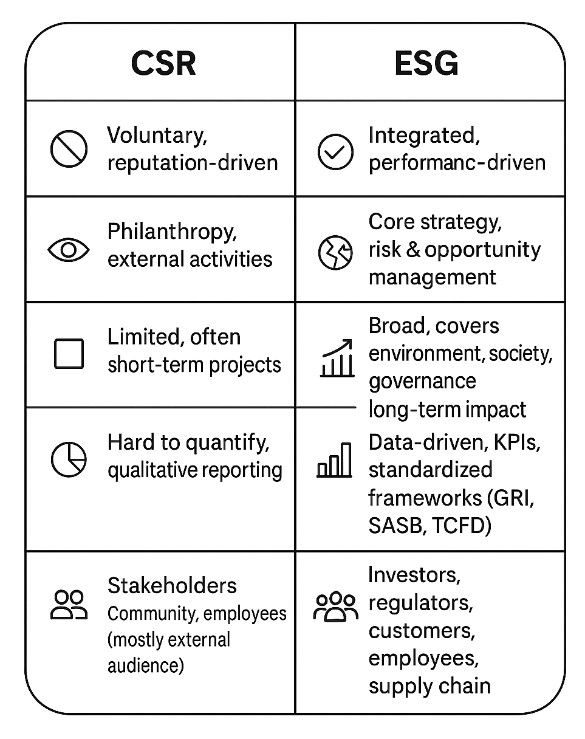
In contrast, Corporate Social Responsibility often encompasses voluntary activities, charitable giving, employee volunteer programs, or sponsorship of green initiatives; that, while valuable, may remain disconnected from the company’s core business model. CSR tends to be externally oriented, focusing on reputation-enhancing gestures rather than embedding sustainability into daily operations. Figure 1. shows a detailed comparison between traditional CSR approaches and the more integrated ESG framework.
Why ESG Matters
- Access to Capital: Institutional investors and asset managers increasingly screen portfolios for ESG performance. Companies with strong ESG ratings benefit from lower capital costs and broader access to financing, while laggards face divestment or higher borrowing rates.
- Risk Management: Climate-related risks—extreme weather, regulatory shifts on carbon pricing, or reputational damage from social scandals—can materially impact earnings. An ESG lens helps identify, quantify, and mitigate these risks before they crystallize.
- Competitive Advantage: Proactive ESG strategies drive innovation in product design, supply-chain resilience, and operational efficiency. Firms that pioneer circular business models, sustainable materials, or equitable labor practices often capture new market segments and foster customer loyalty.
- Regulatory Compliance: Governments worldwide are tightening disclosure requirements around greenhouse gas emissions, human rights due diligence, and board accountability. Early adopters of comprehensive ESG reporting frameworks (e.g., GRI, SASB, TCFD) gain a head start in meeting evolving regulations.
- Stakeholder Trust: Customers, employees, and communities demand transparency on social and environmental impacts. By publishing verifiable ESG metrics, companies build credibility and strengthen their social license to operate.
Integrating ESG into Corporate Strategy
Successful ESG adoption begins with leadership commitment. Boards and C-suite executives must articulate clear sustainability targets, backed by dedicated resources and cross-functional task forces. Key steps include:
- Materiality Assessment: Identifying the ESG issues most relevant to the company’s industry, geography, and stakeholder base.
- Goal Setting: Establishing science-based targets for carbon reduction, diversity metrics, and governance benchmarks.
- Performance Metrics: Implementing data systems and key performance indicators (KPIs) to track progress.
- Transparent Reporting: Disclosing results in annual sustainability reports or integrated financial statements, aligned with recognized frameworks.
Challenges and Future Outlook
While ESG adoption offers clear benefits, companies often struggle to consolidate ESG metrics across disparate systems, such as ERP for energy data, HR platforms for workforce statistics, procurement tools, and spreadsheets, requiring manual extraction, harmonization of inconsistent definitions, thorough data cleaning, and periodic uploads. This process is time-consuming and highly error-prone. Aligning short-term financial incentives with long-term sustainability goals requires recalibrating performance bonuses and embedding ESG metrics into executive compensation.
Looking ahead, the ESG landscape will continue to evolve. Developments in green taxonomy legislation, advances in impact measurement technology, and growing consumer activism will further drive businesses to elevate their sustainability ambitions.
Conclusion
As environmental and social imperatives accelerate, ESG is no longer a niche concern but a strategic imperative for businesses aiming to thrive in a changing world. By embedding robust ESG frameworks into corporate DNA, companies can manage risk, unlock new opportunities, and contribute to a more sustainable global economy.